Ad Blocker Detected
Our website is made possible by displaying online advertisements to our visitors. Please consider supporting us by disabling your ad blocker.
We’ll examine whether the PHILIPS Countertop Reverse Osmosis Water Filter’s five-stage system and compact, no-plumbing design suit everyday use. It’s rated to reduce TDS and certain contaminants, while its two-liter reservoir and electrical requirements shape how conveniently we can use it. We’ll also weigh filter life, refill frequency, and ongoing costs—because the headline filtration rating doesn’t tell the whole story.
Key Takeaways
- The Philips countertop reverse osmosis filter uses five-stage filtration rated down to 0.0001 micron to reduce TDS, lead, calcium, and chromium III.
- Its compact 5 × 13 × 14-inch design needs only a standard electrical outlet, with no plumbing or installation required.
- The detachable two-liter reservoir dispenses 16.9 ounces per button press but may need frequent refilling in busy households.
- Filters last up to 12 months, depending on use and water quality; replacement costs add to ongoing ownership expenses.
- It offers convenient filtration for homes, dorms, offices, and RVs, but requires electricity and does not replace disinfection for unsafe water.
Compact Countertop Design
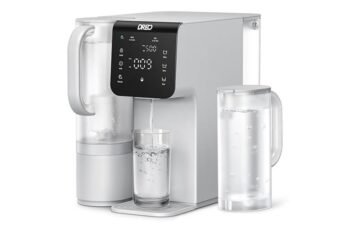
The PHILIPS countertop dispenser keeps installation simple: its 5 × 13 × 14-inch footprint fits on a counter, and its corded electric operation requires no plumbing. We can place it in a home, apartment, dormitory, office, or RV where a standard outlet is available.
Its space saving footprint helps preserve usable counter area, though we should measure the intended spot and allow room to access the unit. The portable countertop setup also lets us relocate the dispenser when needs change, without disconnecting water lines.
For renters or temporary spaces, this plug-in design avoids permanent installation and makes setup straightforward.
Detailed features
Beyond its compact setup, the PHILIPS ADD5930BK/37 uses five-stage reverse osmosis filtration rated down to 0.0001 micron. We can consider its treatment and upkeep together:
| Feature | What it does |
|---|---|
| Five Stage Filtration | Reduces TDS, lead, calcium, and chromium III |
| Aquaporin Inside® | Technology tested with NASA and ESA |
The Filter Life Indicator signals when replacement is due; each filter lasts up to 12 months, depending on use. A detachable, two-liter reservoir holds nine cups, while each button press dispenses 16.9 ounces. We should note that NSF/ANSI/CAN 372 certifies lead-free materials, not water purity. Don’t use this unit with microbiologically unsafe or unknown-quality water without adequate disinfection.
Pros and Cons
Let’s weigh the PHILIPS filter’s advantages, including five-stage reverse osmosis, compact installation-free use, and a filter rated for up to 12 months.
We’ll also consider its trade-offs, such as the need for electricity and its unsuitability for untreated water of unknown microbiological safety. This balance will help you decide whether its features fit your space and water needs.
Pros
PHILIPS’s countertop RO dispenser stands out for combining five-stage filtration down to 0.0001 micron with a compact, plug-in design that needs no plumbing. We can place it in an apartment, dorm, office, or RV and start dispensing without installation.
Its Aquaporin Inside® technology, tested with NASA and ESA, supports its filtration effectiveness; the system reduces TDS, lead, calcium, and chromium III. A detachable two-liter reservoir and 16.9-ounce button dispensing make everyday use straightforward, while a filter-change indicator helps us track maintenance.
With a filter lasting up to 12 months and replacing as many as 4,000 bottles, it offers reduced plastic waste.
Cons
Although the PHILIPS dispenser is easy to set up, its two-liter reservoir may need frequent refilling in busy households, and each button press dispenses only 16.9 ounces.
We may also find its countertop footprint inconvenient in cramped kitchens, despite its compact design. Filter replacement costs add to ongoing ownership expenses, and the filter’s stated lifespan of up to 12 months can vary with water use and quality.
Its power dependence limits operation during outages and rules out locations without an electrical outlet.
Finally, reverse osmosis reduces dissolved substances but doesn’t make microbiologically unsafe or unknown-quality water safe without adequate disinfection, so source-water safety still matters.
Concluding thoughts
Overall, the PHILIPS ADD5930BK/37 offers a compact, plumbing-free way to reduce TDS and selected contaminants through five-stage reverse-osmosis filtration. We’d weigh its convenience against filter costs and the need for electricity.
| Consideration | Assessment | Practical meaning |
|---|---|---|
| Filtration | 0.0001-micron RO | Reduces TDS and specified contaminants |
| Setup | Countertop, plug-in | No plumbing installation |
| Capacity | 2-liter reservoir | Refill as needed |
| Maintenance | Filter lasts up to 12 months | Check replacement costs |
For long term value, compare filter pricing with your bottled-water use; each filter may help avoid up to 4,000 bottles. Ideal users include apartment residents, dorm occupants, RV travelers, and offices seeking convenient dispensing. Don’t use it on unsafe or unknown-quality water without adequate disinfection.
Frequently Asked Questions
Is the PHILIPS Countertop Reverse Osmosis Filter Safe for Microbiologically Unsafe Water?
No. We shouldn’t use this filter with microbiologically unsafe water or water of unknown quality unless we disinfect it adequately first. Its filtration claims don’t establish microbial safety or guaranteed pathogen removal.
Does the Dispenser Remove Beneficial Minerals From Drinking Water?
Yes, we should expect some beneficial minerals to be reduced: reverse osmosis lowers dissolved substances, including calcium. Mineral retention isn’t specified. For remineralization options, we can add minerals afterward; the provided information doesn’t confirm built-in remineralization.
How Can I Check Whether the Filter Needs Replacing?
We can spot a filter’s last gasp by checking its indicator: follow the replacement schedule, changing it when prompted or after up to 12 months. We shouldn’t wait for water quality to decline before replacing it.
What Should I Do if the Dispenser Stops Working?
If the dispenser stops working, we should check power and inspect connections first. We’ll confirm its cord’s firmly plugged in, reseat the detachable reservoir, and consult Philips customer service if operation doesn’t resume; don’t attempt internal repairs.
How Can I Contact PHILIPS About Warranty Support?
When warranty clouds gather, we can contact Philips customer service for support; ask about Philips warranty contact channels and the warranty claim process. Keep your model number, proof of purchase, and issue details ready.
Conclusion
We find the PHILIPS countertop reverse osmosis filter a practical choice when plumbing isn’t an option. Its five-stage system filters down to 0.0001 micron, and its compact, 5 × 13 × 14-inch footprint suits apartments, offices, and RVs. But the two-liter reservoir needs frequent refills, and the unit requires power and ongoing filter purchases. As the saying goes, “The proof is in the pudding”: weigh that upkeep against convenient, on-demand filtration. Remember, RO filtration doesn’t disinfect unsafe water.