Ad Blocker Detected
Our website is made possible by displaying online advertisements to our visitors. Please consider supporting us by disabling your ad blocker.
We’ll assess how the NU Aqua 8-Stage Countertop RO System handles filtration, daily convenience, and ongoing costs. Its plug-in design, UV-C treatment, and tool-free filter changes may suit renters and small spaces, but its modest tank capacity and 4:1 drain-water ratio raise practical questions. We’ll weigh its features and trade-offs to see who’s most likely to benefit—and who may find its limits hard to overlook.
Key Takeaways
- The NU Aqua combines eight filtration stages—including sediment, carbon, reverse osmosis, and UV-C treatment—to reduce particles, chlorine, dissolved substances, and microbes.
- It supports feed water up to 300 ppm TDS and stores treated water in a 1.3-gallon tank.
- Touch controls show water quality and tank level, offer cup-size settings, and provide filter reminders; cartridge changes are tool-free.
- Plumbing-free setup suits renters, offices, RVs, and kitchens without water-line access, but the countertop unit needs dedicated space.
- Its 0.26-liter-per-minute flow, 4:1 pure-to-drain ratio, and ongoing filter costs are trade-offs to consider.
Eight-Stage RO Filtration
The NU Aqua uses an eight-stage process that combines sediment and carbon filtration, reverse osmosis, and UV-C treatment. Sediment filtration targets suspended particles, while carbon stages address chlorine and related taste or odor concerns.
The RO membrane is the central barrier for dissolved substances, including heavy metals and total dissolved solids. The system supports feed water with up to 300 ppm TDS; this limit helps define suitable source water and expectations for Membrane performance.
UV-C adds a treatment step after filtration. Together, these stages are designed for contaminant reduction, though actual results depend on feed-water quality and filter condition.
Detailed features
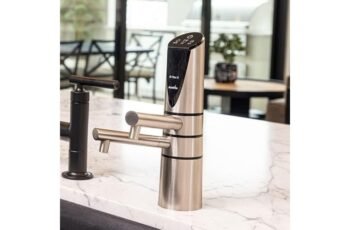
Beyond filtration, the NU Aqua adds practical controls for everyday use: its touch display shows water quality and tank level, offers multiple cup-size settings, and signals when filters need replacement. We can use the Touchscreen controls to select a serving size and check the reservoir at a glance. These maintenance reminders indicate when filter changes are due, while self-cleaning and self-flushing functions support routine upkeep.
The 1.3-gallon internal tank stores treated water, and the system dispenses at up to 0.26 liters per minute. With a 4:1 pure-to-drain ratio, it uses four parts feed water for each part produced. Plug-in operation requires no plumbing.
Pros and Cons
We’ll weigh the system’s eight-stage filtration, UV-C treatment, and plumbing-free setup against its 1.3-gallon capacity and 4:1 pure-to-drain ratio.
We’ll also consider its 0.26-liter-per-minute flow rate and 300-ppm feed-water TDS limit. These trade-offs will help us assess its practical strengths and limitations.
Pros
For households that want reverse osmosis without plumbing, the NU Aqua’s plug-in design, tool-free filter changes, and 1.3-gallon tank make setup and routine use straightforward. We can place it on a counter and use it in kitchens, offices, apartments, or RVs without connecting a water line.
Its Space saving design suits settings where under-sink installation isn’t practical. Eight filtration stages, including reverse osmosis and UV-C treatment, target sediment, chlorine, heavy metals, and dissolved solids.
The touch display shows water quality and tank level, while cup-size options support different uses. Filter reminders, self-cleaning, and self-flushing contribute to easy maintenance and consistent daily operation.
Cons
Although the NU Aqua avoids plumbing, its 1.3-gallon tank and 0.26-liter-per-minute flow rate may limit how quickly we can fill larger containers or serve several people. We’ll need to plan refills around its limited flow rate, especially during meal preparation or busy periods.
The 4:1 pure-to-drain ratio also means the system sends more water to the drain than it produces as purified water, which may concern households monitoring water use. Its countertop footprint requires dedicated space, and replacement filter costs add an ongoing expense.
Although tool-free changes simplify maintenance, we’ll still need to track filter reminders and replace cartridges to maintain performance.
Concluding thoughts
Overall, the NU Aqua 8-Stage Countertop RO System combines eight-stage filtration, UV-C treatment, and a 1.3-gallon tank in a plug-in design that doesn’t require plumbing. Its sediment, carbon, and RO stages target contaminants including chlorine, heavy metals, and TDS, though feed water must stay at or below 300 ppm.
We’d value the touch controls, filter reminders, self-cleaning functions, and tool-free filter changes for everyday use. The 4:1 pure-to-drain ratio and 0.26-liter-per-minute flow rate are important trade-offs to weigh.
For renters, offices, RVs, and kitchens without plumbing access, it may suit ideal users; assess replacement costs when judging long term value.
Frequently Asked Questions
Does the System Require a Dedicated Faucet or Plumbing Connection?
No, we don’t need a Dedicated Faucet or Plumbing Setup. We can plug the countertop unit into an outlet and use it without plumbing, making installation straightforward for kitchens, offices, apartments, and RVs.
Can It Be Used With Well Water?
We can’t confirm Well water compatibility from the specifications; the system supports feed water up to 300 ppm TDS. Check your well water first, and assess pretreatment requirements for contaminants or sediment beyond its stated capabilities.
How Often Should the Filters and RO Membrane Be Replaced?
We can’t specify exact intervals without the manufacturer’s schedule; the system’s replacement reminders help. Its eight stages include the RO membrane. Check your manual for the Filter replacement schedule and membrane lifespan guidance, and replace filters when prompted.
Does the System Need to Be Drained Before Moving?
Yes—we recommend draining the 1.3-gallon tank before moving. For drainage before moving, empty stored water and run the dispensing function; transport precautions include keeping the unit upright, securing loose parts, and protecting its power cord.
Is the Water Tank Removable for Cleaning?
We can’t confirm Tank removal from the available specifications, so don’t assume the tank detaches. Although Cleaning access may seem limited, we can verify the unit offers self-cleaning, but the manual should clarify tank cleaning procedures.
Conclusion
We find the NU Aqua 8-Stage Countertop RO System a practical choice when you want multi-stage filtration without plumbing or permanent installation. Its touch controls and tool-free filter changes simplify upkeep, while UV-C treatment adds another purification step. Still, the 1.3-gallon tank may require refills during busy periods, and its 4:1 pure-to-drain ratio means producing one gallon of filtered water uses four gallons for the process. We’d weigh that water cost and replacement filters against its rental-friendly convenience.